
NavOut: How Data Unification and Signal Intelligence Accelerates Model Deployment for Precision Discovery
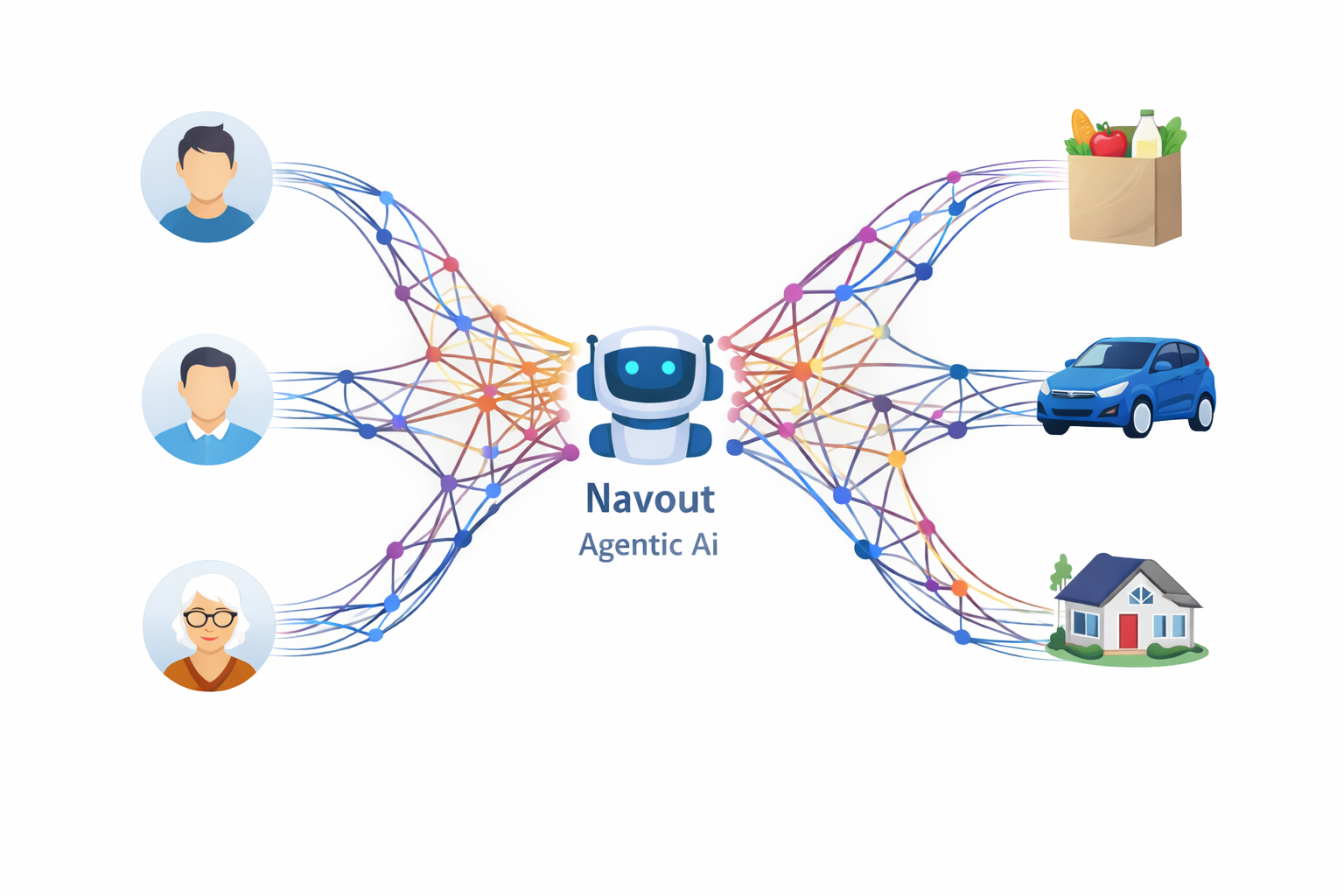
Large companies and enterprises have no shortage of customer and product data. The persistent constraint is how long it takes to unify that data into a model that can improve discovery while a customer is actively exploring. McKinsey has described personalization at scale as a combined business and technology challenge that requires coordination across every facet of the business. Approached without clarity, this process can be enormously expensive in both time and money. NavOut exists to drive impact and guidance for teams looking to create best-in-class recommendation systems.
NavOut reduces the time and technical debt that results from this process. It unifies disparate signals, including text and images alongside structured catalog and behavioral data, and then optimizes a model through stable interfaces that can power discovery surfaces such as recommendations, reranking, matching and much more.
In complex commercial environments, speed must coexist with governance. Our platform also allows for secure data partnerships; ideal for brand collaborations and cross-selling across markets, not just single environments.
This post explains what fast data unification means for modern commerce, why multimodal systems like NavOut’s raise the bar for signal quality, and what some recent implementations of NavOut’s solutions in this area suggest about how unification can translate into measurable lifts in recommendation relevance and model deployment.
Why Data Science teams stall even when they have strong data
Most enterprises already run a sophisticated stack: ecommerce platforms, analytics, identity tooling, experimentation, lifecycle messaging, loyalty systems, customer support platforms, and content pipelines. Each component can be best in class and still produce fragmented recommendation systems because the data is not unified in a way that supports the moment of consumer engagement.
A common pattern is that product data is clean but incomplete, while behavioral data is rich but hard to interpret, and customer identity is split across channels and devices. The result is an organization that can report what happened last month but struggles to personalize what should happen next in the current session. Our blueprint emphasizes that the challenge is not only collecting data, but making it available and actionable across channels in a coordinated way.
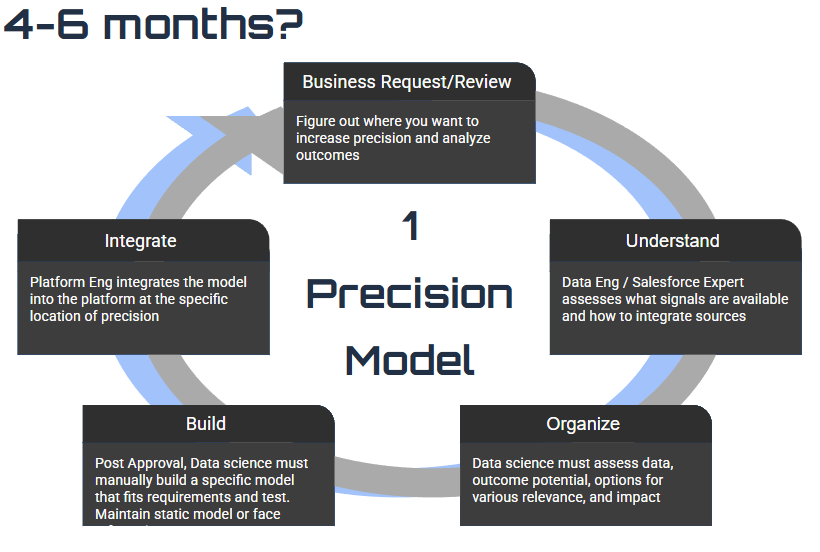
This is also why many personalisation efforts slow down after initial wins. The first models are deployed and provide relevance lift. This can be driven by simple segments and popular items. The harder work is moving from generic ranking to personalization that impacts every user as individual entities. Precise recommendations that respond to intent shifts, new product launches, and regional differences without needing a multi quarter rebuild.
Unification that matters is not storage
Data unification is often framed as a warehouse project. In practice, the outcome that matters is not where the data lives. It is whether the data is usable for retrieval and ranking at interaction speed.
It helps to separate three layers:
Data availability:
Can you access the relevant signals across systems with acceptable latency and reliability?Semantic consistency:
Do “the same” fields mean the same thing across brands, regions, and tools, or are you joining incompatible concepts?Activation readiness:
Can the system assemble evidence and produce a recommendation or match in the moment, with constraints and explanations?
A unified profile foundation is valuable, but discovery still requires logic that can interpret intent, content meaning, and context in real time. Most companies spend 3 to 6 months iterating this process.
Our platform can bring that iteration time way down. NavOut’s agentic discovery loop does the following: captures user intent, unifies and defines key signals, personalizes recs by user, and improves as outcomes feed back into the system. This matters because the system is designed around model flexibility and use case specific outputs, not just unified storage.
Why multimodal precision is becoming a baseline requirement
Discovery is increasingly multimodal because buyers decide using more than structured attributes. They read descriptions and reviews, evaluate imagery, compare variants, and interpret context such as delivery promises and usage constraints. That means a discovery system needs to represent products and preferences across multiple modalities.
For both large companies and enterprises, this has a straightforward implication: precise personalization depends on utilizing the full meaning of product content and the full meaning of buyer behavior. If the system relies only on historical transactions or simple click co occurrence, it will struggle when customers are new, products are new, or intent shifts quickly.
A bit more about the NavOut approach: one hub for precision models and explainable decisions
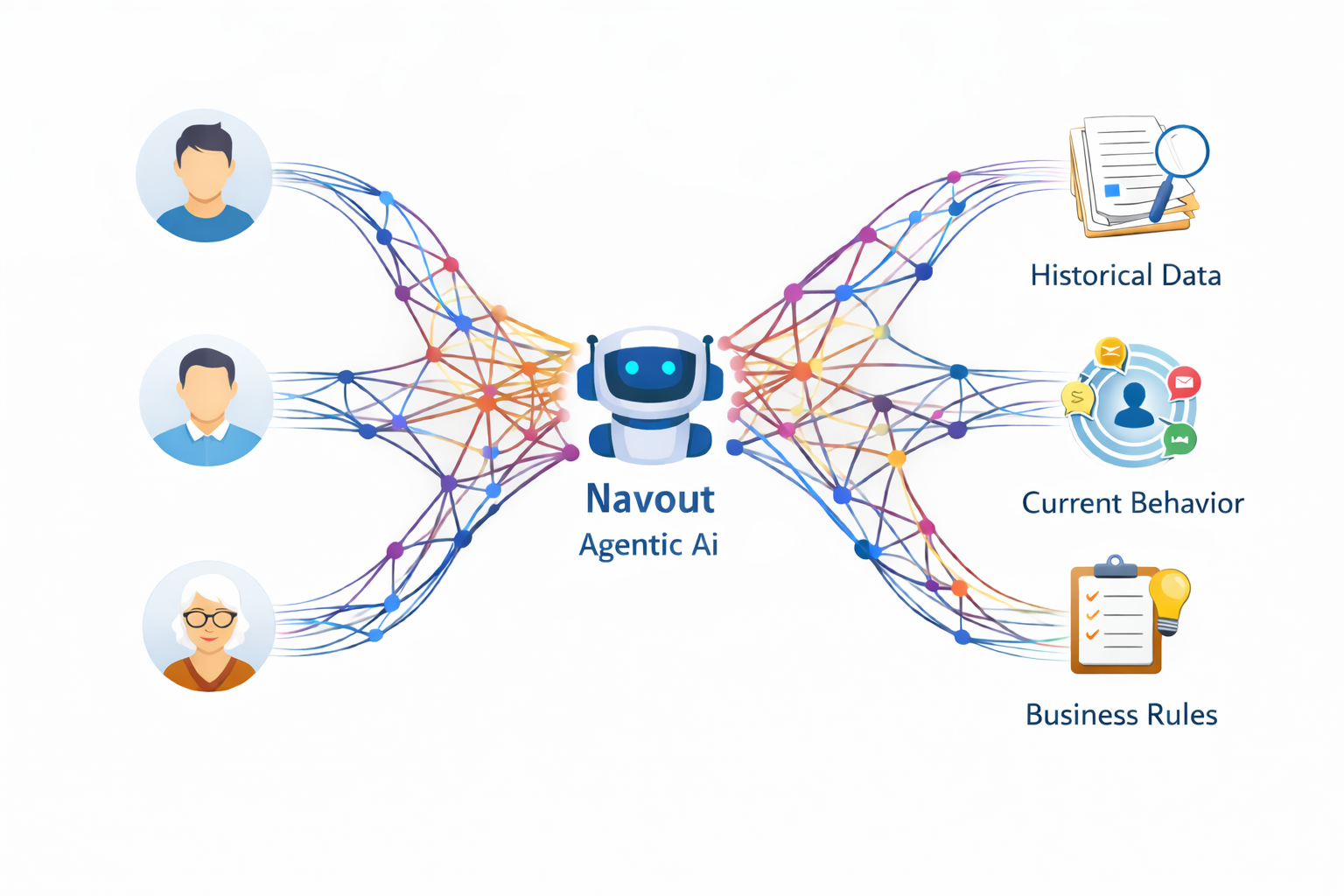
NavOut functions as the layer that unifies signals and then deploys models through interfaces that can be integrated into existing experiences. NavOut offers low lift integration and signal optimization via flexible models intended to support personalization without heavy retraining cycles.
Conceptually, the system follows a practical sequence that aligns with how teams actually ship:
CONNECT: Connect and normalize key sources:
Bring together catalog content, behavioral events, and explicit preference signals, and normalize them into a consistent taxonomy and identity context.AUTOMATE: Generate unified representations and decision outputs:
Create representations that support retrieval and ranking, and produce outputs that can be consumed by onsite components, search reranking, matching flows, and downstream activation.SCALE: Iterate through explainable feedback:
Use interaction outcomes to refine signals and model objectives without requiring heavy rebuilds for every new hypothesis.
The benefit of this pattern is organizational, not only technical. A single hub reduces coordination costs across teams. Product, marketing, data, and engineering teams can work from the same notion of intent, constraints, and objectives rather than shipping disconnected logic.
Learning the right signals from your data, then aligning to business preferences in plain language
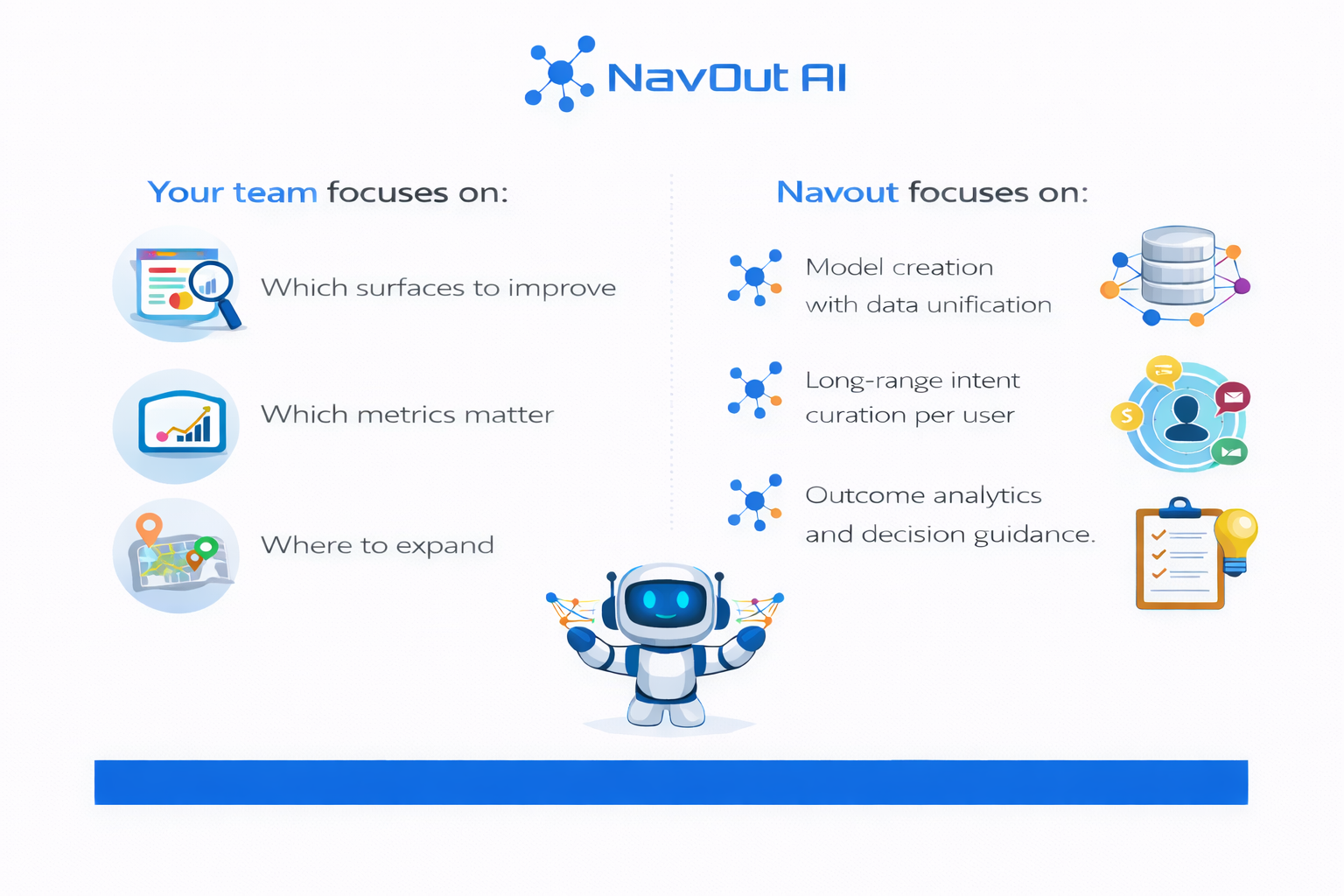
Once NavOut is connected to a client’s data (events, catalog metadata, zero party inputs, behavioural data, etc.), the system jointly learns what matters for that specific business rather than relying on generic feature templates. Interactions are tokenized into a consistent sequence format, so the model can learn patterns across time (what a user does first, what they ignore, what they come back to) and connect those behaviors to the downstream objective. A single training objective then updates the system end to end, so signal quality improves as a whole instead of drifting across brittle pipelines.
Practically, this means the system can surface to clients which signals are actually predictive for this product, this catalog, and this audience. For example, which behaviors indicate exploration versus intent, which zero party answers reduce ambiguity, and which product attributes drive better matches. Teams can use that to focus instrumentation on the highest value events and clean up noisy or redundant inputs.
Importantly, the system is not a black box that forces one definition of best. After learning from data, the experience can be steered with natural language preference prompts that translate business rules into model guidelines, without requiring teams to rebuild the underlying model logic. For example:
• “Prioritize in stock items and deprioritize low margin SKUs unless the user shows strong intent”
• “Increase variety early in the session, then narrow to best match products after the user answers two questions”
• “For new users, optimize for first successful match. For returning users, optimize for repeat purchase and replenishment”
This combination of high quality data and trained signal discovery alongside promptable preference alignment lets the system stay grounded in real user behavior while still reflecting how the business wants decisions made.
A practical starting point that avoids long rebuilds
The safest way to start is to pick one moment of engagement where relevance is measurable and where your stack currently forces generic experiences.
Many enterprises begin with one of these:
First session onboarding and guided discovery:
Especially effective when customers are new and you need zero party signals to avoid guessing.Search reranking and category navigation:
High leverage because it touches a large share of traffic and can be evaluated with clear metrics.Onsite recommendation modules:
Useful when you want to reduce decision fatigue and improve cross-selling without changing the entire site.
The operational sequence matters. Define the minimal set of signals that make the decision better, unify only what you need, deploy quickly, and then expand the signal set once governance is proven. That is how you avoid turning unification into a multi quarter dependency.
Closing thoughts
Fast unification is not about building a bigger pool of data. It is about making the right signals usable for the right model at the moment the customer is deciding, while maintaining the governance required for complex commercial environments. That is what changes model deployment from a quarterly event into a continuous capability.
When considering whether you want to explore our solution take this question back to your team:
When a buyer’s intent shifts mid session, or when you need to develop a new set of parameters for your current models; how long does it take your organization to reflect that change in the decisions your experience delivers?
Sources and further reading about this topic
A technology blueprint for personalization at scale, McKinsey and Company, May 20, 2019. https://www.mckinsey.com/capabilities/growth-marketing-and-sales/our-insights/a-technology-blueprint-for-personalization-at-scale
Unlocking the next frontier of personalized marketing, McKinsey and Company, January 30, 2025. https://www.mckinsey.com/capabilities/growth-marketing-and-sales/our-insights/unlocking-the-next-frontier-of-personalized-marketing
Multimodal Recommender Systems: A Survey, ACM Computing Surveys, 2024. https://dl.acm.org/doi/10.1145/3695461
NavOut Solutions for Technical Teams: https://www.navout.ai/solutions/technical
