Choice heavy product? Find out how we drove down search time by 30 minutes and delivered 8x Route Completion with our approach

Unlocking Personalized Adventure With Fast Data Unification and Signal Intelligence
Why discovery stalls even when data exists
Most organizations already run a modern stack. Each system can be strong on its own and still produce a weak discovery experience because the data is not unified in a way that supports the moment of engagement.
A common failure mode looks like this:
Product information is rich but inconsistent. Attributes vary by region, by content owner, or by historical catalog conventions. Unstructured text is abundant but not normalized.
Behavioral data is plentiful but hard to interpret. Clicks, saves, searches, and browsing sessions carry intent, but the meaning is ambiguous unless mapped to a consistent representation of the items.
Profiles are thin at the moment they matter most. Many customers arrive without a long history, so the system guesses, shows broad lists, and pushes the work back onto the user. The outcome is predictable: slower time to a confident choice, more backtracking, and lower completion rates. The business outcome is also predictable: personalization becomes a multi month effort because teams keep rebuilding pipelines and debating which signals matter.
NavOut approaches this differently. The platform is designed to reduce time to deployment by making data unification and signal selection part of a repeatable process, not a bespoke project every time.
A case study in uneven data: Climb and Trail Finder
Climb and Trail Finder is a route discovery subscription product with over 1.5 million options across disciplines like hiking, biking, and climbing. The data is community driven, which gives it breadth and freshness, but also creates inconsistency. Users contribute reviews, posts, and media that contain valuable context, yet much of that context is unstructured.
The core problem was not a lack of content. It was the opposite. Search and discovery were constrained to narrow queries like a known route name or region. Valuable context existed in community content, but there was no reliable way to translate that context into precise, user level recommendations. Structured data coverage was limited, and the system lacked profile enrichment strong enough to personalize by individual intent.
The goal was to unify disparate sources into single source user profiles and use that unified layer to generate precise recommendations that make route finding feel immediate. In practical terms, this meant producing top options quickly, with reasoning that reflects what the user actually cares about.
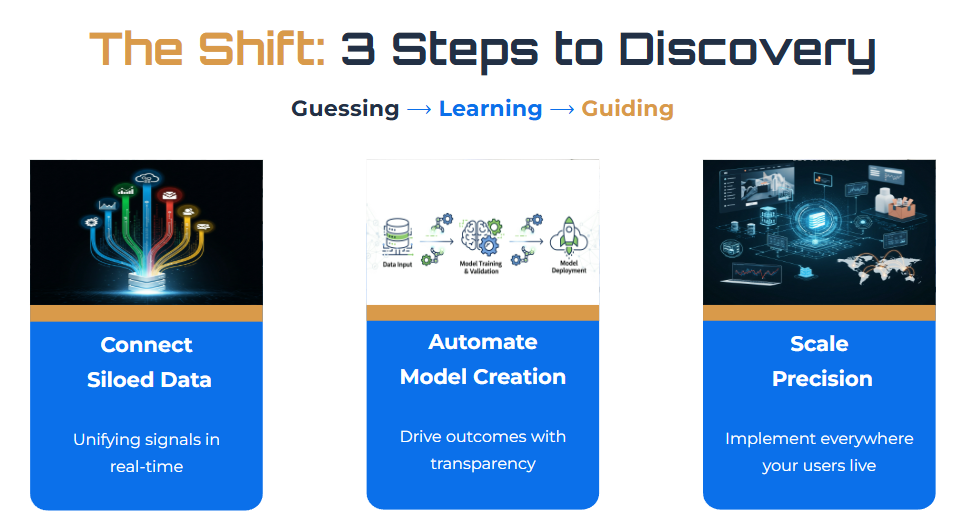
NavOut process: Connect, Automate, Scale
To make this example transferable beyond outdoor discovery, it helps to frame it in NavOut’s deployment process.
1. Connect: Unify the data and drill down on the best signals
Fast model deployment starts with a disciplined definition of what needs to be unified, and why.
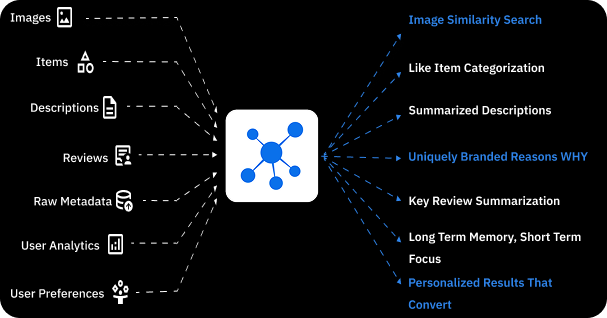
In this case, NavOut connected signals across four categories:
User behavior signals:
Past clicks, saved favorites, completed routes, and search behavior provide strong indicators of preference, but only if they are consistently mapped to item meaning.Zero party intent signals:
A lightweight onboarding flow captures explicit preferences, such as difficulty comfort, energy level, and range. This makes intent legible immediately, which is especially important when the user has limited history.Content and community signals:
Reviews, posts, and free text descriptions contain the most useful context, but in an unstructured format. Images also encode preference, both in what people upload and in the visual characteristics of routes and environments.Structured anchors:
Where structured metadata exists, such as grading and geolocation, it becomes the anchor for objective constraints like difficulty and proximity.
The result is not just a merged dataset. It is a unified representation of the user and the options that is stable enough to support retrieval and ranking. This is where many discovery systems fail: they ingest more data without resolving semantic drift.
2. Automate: Model Production and Deployment
Once your data and signals are connected, the platform creates models your business can easily integrate into your site.
In Climb and Trail Finder, this included:
Image similarity matching
Users could express preference through images of trail scapes or environments they enjoy. The system then finds visually similar routes, which is a powerful shortcut when a user cannot describe what they want with structured fields.Image captioning and content summarization
Route images and community content were converted into concise descriptions. Reviews and route descriptions were summarized into user friendly language that highlights what tends to matter most for selection.Session level matching with real time updates
As the user interacts, the system updates recommendations based on new signals in session, rather than waiting for offline retraining cycles. This makes the experience feel responsive.Profile enrichment using NavIQ and NavVision
NavIQ supports preference capture and profile enrichment. NavVision supports multi modal understanding of images and text, so the unified profile reflects both behavior and content meaning.
The most important design choice was the output format. Instead of returning a long list, the system generated a curated landing experience:
Top 6 routes per sport, personalized to the user’s inferred and explicit preferences
A structured exploration set for breadth, grouped into easy, average, and hard options to support discovery without forcing search
A curated description and a reason why for each recommended option, so the user understands why an option fits
This is the difference between unification for analytics and unification for personalization. The system is optimized to reduce the user’s work in session, not to produce a perfect dataset.
Crucially all of this process was executed within our dashboard (low code environment), and allows for easy access to model reasoning and signal intelligence via natural language prompting.
3. Scale: Measure outcomes and avoid full rebuilds and long retraining cycles
We believe fast model deployment and experimentation is the key to best in class personalization. We have built an approach to model development that improves and learns continuously, while also allowing teams to steer objectives and constraints. This makes scaling the insights of successful models far faster.
In this case, the outputs were tested by verifying that combined search and profile information led to better matches, including image similarity against past completions and summarized descriptions that reflect what the user likes most.
The reported outcome was a large reduction in time spent searching and a significant increase in selection and completion behavior. In the case study reporting, users spent around 30 fewer minutes searching, roughly a 20x time savings, alongside an 8x increase in conversion and route completion.
Because of our approach, what works in a market, can easily be retuned for another. We believe the best approach is to land on one surface and expand to others as the platform unifies learnings and assembles rich representations of your users’ and business’ data. All of this with minimal technical lift.
These results are specific to this use case and evaluation setup. The more general takeaway is the mechanism: when unified profiles include both behavior and content meaning, the system can narrow options early, explain the choice, and help users act faster.