
How The Fourth Effect Used NavOut to Deliver 20x time saving and 15x more listings for their Users
The Fourth Effect is a board governance and advisory marketplace designed to connect founders, advisors, and investors in higher trust ways than a typical directory or job board. It runs programs and events that add even more context to what “fit” means, because the right match is often about timing and goals, not just credentials.
When The Fourth Effect partnered with NavOut, the product challenge was clear. They had meaningful signal, but it was scattered across more than a dozen sources and a lot of it lived in narrative form. Search and discovery were mostly keyword driven, opportunity creation was cumbersome, and ranking was largely default ordering with limited ability to tailor outcomes to what each user was trying to achieve.
Our approach focused on unifying their data (12 sources) and identifying the key signals and connections needed to deliver highly relevant recommendations. The implementation combined three NavOut models in one guided flow: enrich each participant’s intent and context, generate structured opportunities from unstructured inputs, then match founders, advisors, and investors with a rationale that supports a first conversation.
The starting point: three sided matching, three different definitions of fit
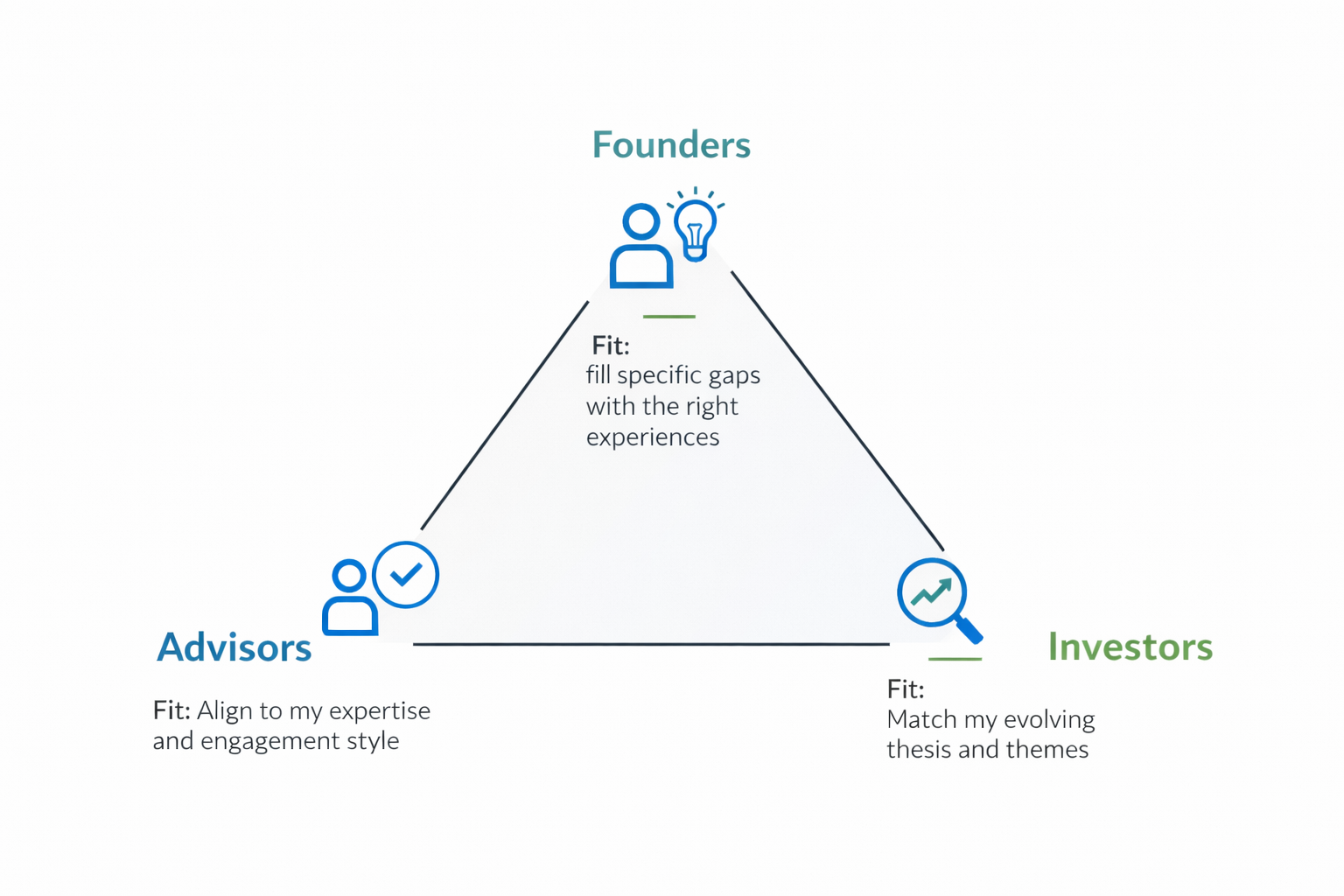
Marketplaces like The Fourth Effect have a built in complexity that traditional personalization systems do not handle well. Founders are not simply browsing. They are trying to build a board or advisory bench that fills specific gaps, at a specific stage, with constraints around time, compensation, and the kind of operating experience that matters right now.
Advisors, directors, and executives are not simply searching for roles. They are looking for opportunities aligned to their expertise, values, availability, and the type of engagement they want, whether that is a formal board seat, an advisory role, or a lighter touch introduction to the ecosystem.
Investors also have a different model of fit. They care about themes and pattern recognition. Their signal is often expressed in language rather than filters, and it changes over time.
The Fourth Effect already had many of the raw ingredients across profiles, listings, and engagement, plus additional context created through events and community programming. The problem was that this context was not contributing to their online product. It was hard to unify, hard to interpret consistently, and hard to operationalize as recommendations that people trusted.
Why the Traditional Approach was Inappropriate
Many marketplaces try to solve this by building one ranking algorithm and feeding it more features over time. That approach usually stalls for two reasons.
First, the inputs remain inconsistent. When a large share of the useful signal is in free text, notes, and unstructured descriptions, feature engineering becomes a bottleneck and the system never really understands what a listing or a profile means. To do this we:
Connected their various data sources via NavOut APIs
Generated semantically rich interpretations of this data so that our model could ingest it
Second, the user experience needs different kinds of intelligence at different steps. Early in the journey, users need clarity. Later, they need structured options. At the decision point, they need a shortlist with a reason to believe.
For The Fourth Effect, we broke the work into three outcomes that map directly to these needs.
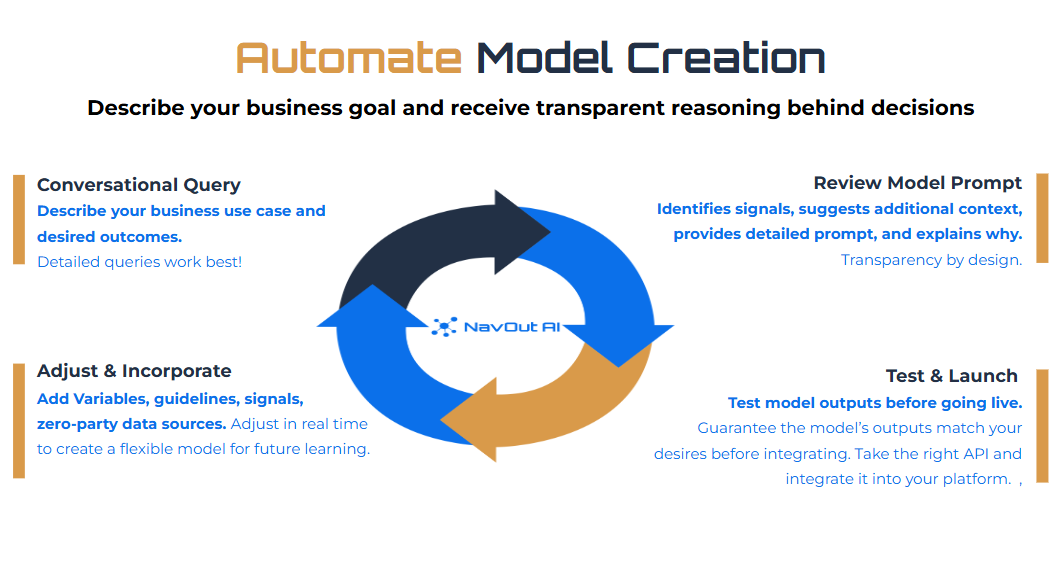
We create a Model. You prompt it to fit you.
The Fourth Effect started by defining a sequence of model queries that mirrored how their marketplace actually creates value. Each query represented a decision the product needed to make well, in order, with clear outputs. Here are brief summaries of their process:
Model Query 1: Clarify the right advisor direction for a startup
The first query was designed for onboarding. Based on a startup’s information, the system returns recommendations that help the founder identify the most relevant types of advisors to pursue, relative to stage and immediate priorities. This reduced early ambiguity and made the first steps on the platform feel directed rather than exploratory.
Model Query 2: Generate an advisor opportunity that reflects real needs
Once the startup’s direction was clearer, the second query focused on converting context into a usable marketplace object. The system generates an advisor listing opportunity that matches the startup’s needs and maps them to the advisor skill sets the marketplace can supply. This reduced the gap between knowing what you need and being able to ask for it in a structured way.
Model Query 3: Match the triangle with intent and fit in both directions
The third query focused on the full marketplace graph. The system matches startups to advisors and investors that best fit their needs, and also matches advisors and investors to startups that align with their experience and investment thesis. The output is designed to support action, not just browsing, by pairing matches with a concise reason why the person or company is relevant.
Model Selection: Combine the right capabilities for each query
After the queries were defined, the model stack was selected to fit the workflow end to end.
NavIQ was used for profile enrichment and intent capture so early signals could be made usable quickly.
NavCompose was used for contextual understanding and listing creation so narrative information could become structured.
NavMatch was used to identify the best professionals to start conversations with, once profiles and listings were coherent.
One onboarding flow, continuous feedback
The system was then implemented as an onboarding flow that combined all three queries into a single guided experience. The Fourth Effect also created a real time feedback loop through onboarding and a survey layer so the outputs could be refined based on what users actually did and what they reported. This made it possible to adjust the model continuously toward the marketplace’s definition of high quality conversations without rebuilding the workflow each time priorities shifted. No long retraining builds. No big model overhaul every 3-6 months.
Results summary
The Fourth Effect used this sequence to make the marketplace feel more decisive at the start of the journey and more structured at the moment of engagement. NavOut delivered:
Hyper personalized onboarding with matching.
Created a real time feedback loop through onboarding and survey inputs.
Provided top advisor types to narrow focus toward high impact connections.
Auto generated listings to reduce friction between knowing and asking.
Matched professionals with the highest intent individuals and included a short reason why the person or company was a fit.
Reported outcomes from the deployment included 20x time saving, 15x more listings created, and we are expecting a minimum of 12x more matches in the coming quarter.
